
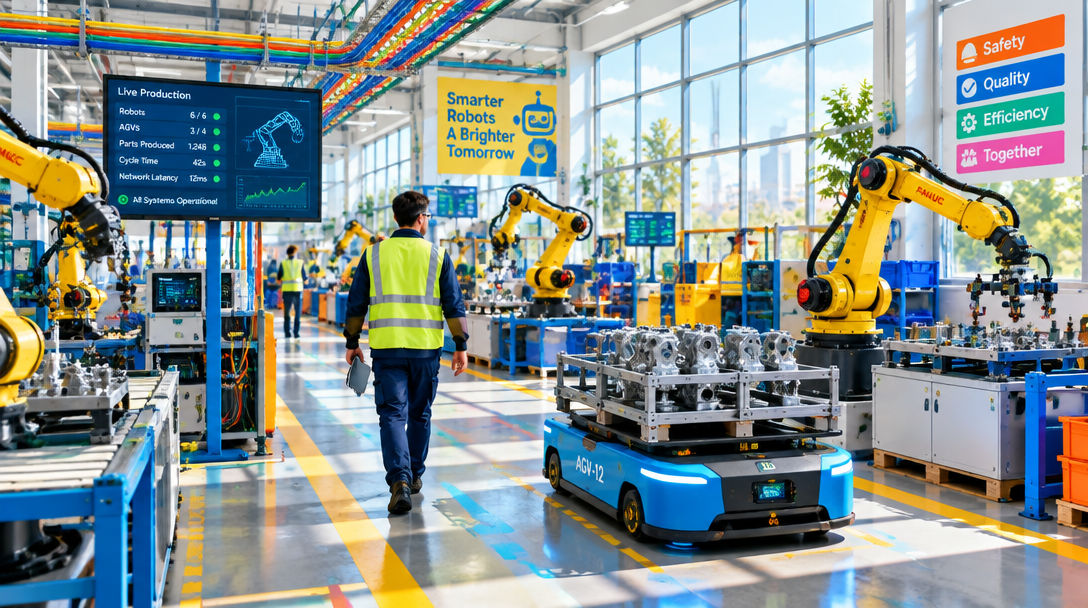
Time-Sensitive Networking (TSN) is a set of IEEE Ethernet standards that makes standard Ethernet deterministic at Layer 2, enabling robots and other real-time systems to exchange time-critical control traffic with bounded timing instead of best-effort delivery. For robotics, TSN synchronizes devices, prioritizes critical traffic, reduces latency and jitter, and allows real-time control to coexist with other data on one Ethernet network.
What is Time-Sensitive Networking (TSN) and how does it benefit robotics?
Time-Sensitive Networking, or TSN, is a set of IEEE Ethernet standards that makes standard Ethernet deterministic at Layer 2, so robots and other real-time systems can exchange time-critical control traffic with bounded timing instead of best-effort delivery. For robotics, the benefit is practical: TSN synchronizes devices, prioritizes critical traffic, reduces latency and jitter, and makes it possible to run real-time control alongside other data on one Ethernet network.
The Real Problem: Best-Effort Traffic in a Real-Time World
A robot cell often fails on the same thing office networks tolerate all day: waiting its turn.
That sounds almost insulting in its simplicity. Yet it is the whole problem. Traditional Ethernet is excellent at moving lots of data cheaply and flexibly, but it was built around best effort delivery. A camera frame, a diagnostics burst, and a motion command all enter the network as packets asking for service. Standard Ethernet does not care that one of them is steering a robot arm while another is just logging temperatures.
Robotics cares. Motion control cares. Safety systems care. If control traffic arrives late or with too much jitter, the machine does not merely slow down. It becomes harder to tune, harder to certify, harder to trust. So engineers built a habit around that weakness: keep the real-time traffic on one network, push everything else somewhere else, and accept the cable sprawl, gateways, and protocol boundaries as the price of determinism.
TSN changes the price.
The common way to describe TSN is that it gives Ethernet low latency. True, but too small. The real shift is architectural. TSN lets one Ethernet network carry different classes of traffic, including the traffic that must arrive on time and the traffic that merely should arrive eventually. Once you grasp that, the old assumption that real-time control demands its own separate world starts to look less like engineering law and more like a workaround that lasted a long time.
If you are planning or maintaining an industrial network, that is the checklist item to put at the top: stop asking only how fast the network is. Ask whether it can tell the difference between traffic that is urgent and traffic that is merely large.
Why Robotics Exposes the Limits of Fieldbus Thinking
Why that matters becomes obvious in robotics, because robots generate both kinds at once. A controller needs tightly timed communication for motion and coordination. The same machine may also stream vision data, diagnostics, configuration traffic, logs, and general IT traffic. The sources provided here make a blunt point that often gets hidden under acronyms: most existing real-time Ethernet solutions were created for low data volume applications such as distributed motion control. That made sense when the hard part was just getting drives and controllers to behave. It makes less sense when the same line also wants high-bandwidth sensing and richer software.
This is where many network designs quietly break. They inherit a fieldbus mindset in an Ethernet age. One channel for control. Another for everything else. Then a bridge between them. Then another exception because a camera does not fit neatly. Then a maintenance headache because timing problems and bandwidth problems now hide on different sides of a protocol boundary.
So the second checklist item is to separate your traffic by requirement, not by tradition. You are looking for classes, not devices. Which messages must arrive predictably enough for control loops or coordinated motion? Which ones need high throughput but can tolerate delay? Which ones need reliability without precise timing? Until you classify traffic that way, every network discussion turns into theology.
TSN exists precisely because Ethernet needed a vocabulary for those distinctions. The supplied material supports three core functions in plain language: TSN synchronizes devices, prioritizes time-critical traffic, and reduces latency and jitter. That combination matters more than any single feature.
The Three Core TSN Functions Robotics Depends On
Start with synchronization. Robotics systems live or die on shared time. If devices disagree about when "now" is, scheduling becomes guesswork. One node thinks it sent on time, another thinks it received late, and troubleshooting turns into superstition. TSN addresses this by synchronizing devices across the network, which gives the rest of the timing behavior something solid to stand on.
Then comes prioritization. Standard Ethernet can move priority traffic first, but TSN pushes further by shaping how time-critical traffic gets access to the wire. That is the difference between "important" and "guaranteed." In robotics, that gap is everything. If a motion update must cross the network inside a known window, it cannot merely compete better than the camera stream. It needs a path through the traffic.
Finally, jitter reduction turns average performance into usable performance. A robot does not care much that ten packets arrived quickly if the eleventh arrived unpredictably. Control engineers tune for worst cases, not pretty averages. A network with low average latency and occasional timing spikes still behaves like a nervous system with dropped beats.
This is why the strongest objection to TSN, while understandable, misses the point. The objection goes like this: dedicated real-time networks already work. They are proven in motion control. Why replace something dependable with standard Ethernet plus extra complexity?
Because the complexity is already here. It is just hiding in the seams.
A separate real-time network looks simple when viewed one protocol at a time. The plant or robot does not experience it that way. It experiences the gateways, duplicated wiring, different engineering tools, isolated diagnostics, and painful handoffs between control traffic and everything surrounding it. Every separate network creates another place where timing stops being visible and starts being translated.
TSN moves the complexity into the network's rules, where it belongs. That is a better place for it. Ethernet already dominates general connectivity. Robotics already needs more than one kind of traffic. Putting deterministic behavior into standard Ethernet means the same infrastructure can carry both hard real-time and ordinary traffic with explicit handling for each class. The value is not elegance for its own sake. The value is fewer boundaries.
That is the third checklist item: count boundaries, not ports. Every time traffic crosses from one networking world into another, ask what you pay in latency, diagnostics, configuration effort, and failure modes. A design with two physically separate networks may feel conservative, but it often stores risk in places that only appear during commissioning or maintenance.
Beyond the Cabinet: TSN, 5G, and Mobile Robots
The turn in this story comes when you zoom in from "industrial automation" to mobile robotics. Fixed machines already suffer from split networks. Mobile systems magnify the problem because they move through spaces where wired determinism is not always possible. The material provided here notes that 5G is the first infrastructure promoting TSN bridge functionality and other architectural advancements. It also points to scenarios involving quickly moving swarms of robots and drones that need to interconnect.
That matters because it extends the argument beyond the cabinet. If deterministic networking remained a purely wired trick, you could treat TSN as an upgrade for stationary cells and leave the rest alone. But once TSN concepts translate across wired and wireless domains, the network stops being a set of islands. It starts to look like a timing system that can follow the robot.
For autonomous mobile robots and AGVs, that is a serious change. They still need traffic with different timing requirements. They still need control, telemetry, perception, and coordination. If the deterministic part of the network can bridge into wireless infrastructure, you do not just gain convenience. You gain continuity. The robot does not switch from a disciplined timing world to a best-effort wilderness the moment it leaves a docking station.
This is also why robotics teams should care even if they are not designing switches or network silicon. TSN sits at Layer 2, below much of the application software stack, but it shapes what the software above can safely assume. A control developer who knows critical traffic can be synchronized and prioritized across shared Ethernet can design differently from one who assumes every burst of noncritical data might randomly upset the loop. In practical robotics work, that changes architecture decisions upstream.
If your team works on broader robot cognition or AI integration, this network question becomes even less optional. Richer perception and inference tend to increase data volume. Control still demands timing discipline. Those two pressures usually pull against each other. TSN is interesting because it gives you a way to stop treating them as enemies. The network layer still decides whether those richer systems can coexist with real-time control on the floor.
A Practical Checklist for Evaluating TSN in Your Design
The fourth checklist item is blunt: identify where you are overpaying for separation. Look for duplicated network hardware, protocol conversion points, isolated diagnostic paths, or systems where high-bandwidth data had to be kept away from control traffic by design. Those are clues that the network lacks a way to express timing requirements directly.
The fifth item is to stop using raw bandwidth as your proxy for readiness. Robotics networks rarely fail because Ethernet is slow in the abstract. They fail because a critical message had to compete with a noncritical one under rules that were never designed for time guarantees. A thicker pipe helps until it does not. Determinism solves a different problem.
The sixth item is the practical one: map your traffic classes. Put every recurring network flow into one of a few buckets. Time-critical control. Safety-related communication if applicable. Vision or other high-volume sensing. Diagnostics and logging. Configuration and maintenance. General IT traffic. Do not overcomplicate the taxonomy. You are not writing a standard. You are trying to see the network as a scheduler sees it.
Once that map exists, the question becomes much cleaner: which of these flows truly require deterministic handling, and which simply need enough throughput? That is the moment when TSN becomes a design tool instead of a buzzword. If only a narrow slice needs precise timing, you can focus your evaluation there. If several classes must coexist on one fabric, the case becomes stronger.
One caution belongs here. TSN is not magic because it is Ethernet, and it is not automatically useful because it is standards-based. The point is not to sprinkle acronyms over a weak design. The point is to replace accidental contention with deliberate traffic handling. If you do not know your traffic classes, update rates, and timing sensitivity, TSN cannot rescue you from vagueness. It will only make the vagueness more expensive.
So the one action worth taking this week is simple: draw a single-page traffic map of your current robot or production network, with each flow labeled by timing sensitivity.
Nothing more ambitious. No migration plan yet and shopping list. No redesign meeting. Just the map. Put control traffic, vision, diagnostics, maintenance, and general data on the same page and mark which ones truly need deterministic delivery. That page usually reveals more than a month of abstract debate, because it shows whether you are protecting a few critical flows or preserving an old habit.
A network that cannot distinguish between a stop command and a video stream forces you to separate them physically. A network that can distinguish them lets you design like an adult.
That is TSN's real promise in robotics. Not faster Ethernet. Smarter coexistence. The future robot will not ask for fewer packets. It will ask for one backbone that knows which packet must never wait.
FAQ
Does TSN replace standard Ethernet?
TSN builds on standard Ethernet. The supplied material describes it as a set of IEEE standards that adds deterministic communication capabilities to Ethernet at Layer 2.
Why does robotics need TSN if ordinary Ethernet is already fast?
Because speed alone does not solve timing uncertainty. Robotics needs low latency and low jitter for real-time traffic, and TSN adds synchronization and traffic prioritization so critical messages are handled predictably.
Is TSN only useful for wired industrial robots?
No. The provided material notes that 5G promotes TSN bridge functionality and is relevant for scenarios with moving robots and drones, which extends deterministic networking beyond fixed wired links.
FAQ
Does TSN replace standard Ethernet?
TSN builds on standard Ethernet. The supplied material describes it as a set of IEEE standards that adds deterministic communication capabilities to Ethernet at Layer 2.
Why does robotics need TSN if ordinary Ethernet is already fast?
Because speed alone does not solve timing uncertainty. Robotics needs low latency and low jitter for real-time traffic, and TSN adds synchronization and traffic prioritization so critical messages are handled predictably.
Is TSN only useful for wired industrial robots?
No. The provided material notes that 5G promotes TSN bridge functionality and is relevant for scenarios with moving robots and drones, which extends deterministic networking beyond fixed wired links.
Questions left? Get in touch →