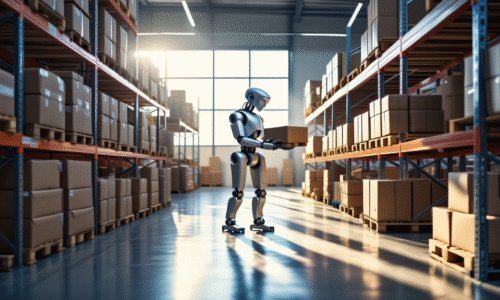
NVIDIA Isaac Sim. Total Immersion is a beginner-friendly, industry-aligned program that takes you from zero to confident creator of high-fidelity robotic simulations. Isaac Sim is part of NVIDIA Omniverse and provides photorealistic rendering, PhysX 5 physics, and robust Python APIs for building, testing, and validating robot behaviors. This course is designed for newcomers to robotics and simulation, developers transitioning into robotics, students preparing for robotics careers, career changers entering AI and automation, and technical professionals who need to simulate, test, or manage robotic systems. No prior robotics or advanced programming background is required.
Across 30 sections and hands-on projects, you will install and configure the full Omniverse and Isaac Sim stack, understand the USD scene framework, create scenes and robots, configure physics and articulations, implement controllers, and simulate sensors. You will program robots via the Python API, build reinforcement learning (RL) and imitation learning pipelines with Isaac Lab, and integrate modern AI models such as Vision-Language Models (VLM), Vision-Language-Action (VLA) models, and Large Language Models (LLMs) for high-level planning. You will also connect simulations to the ROS 2 ecosystem for navigation, manipulation, and real-time control, and learn how to move trained policies from simulation to real robots through domain randomization, calibration, and Hardware-in-the-Loop (HIL) testing.
By progressing through interface fundamentals, physics setup, robot import (URDF/MJCF to USD), controllers (PID, position/velocity/effort, impedance), perception (RGB, depth, LiDAR, IMU), and task building, you will develop practical skills that map directly to professional robotics workflows. You will learn motion planning basics (IK, FK, RRT/PRM), data generation for computer vision, and the design of realistic environments for industrial, household, and outdoor scenarios. The course emphasizes performance optimization, reproducibility, and best engineering practices, including profiling, LOD, collision mesh optimization, GPU utilization, batching, and automated testing with CI/CD.
Specialized modules cover Isaac Lab for RL at scale (parallel environments, observation/action/reward managers, termination conditions), imitation learning (teleoperation, demonstration capture, behavioral cloning, DAgger), and cutting-edge AI integration: using VLMs for visual grounding and natural-language commands, VLAs (e.g., RT-2, OpenVLA, Octo) for end-to-end visuomotor policies, and LLMs for high-level task decomposition, function calling, and safe recovery strategies. You will explore Isaac GROOT generalist policies, multi-embodiment learning, and adaptation to new tasks and robots.
Throughout, you will create complete pipelines: set up robots, sense the world, plan and execute motions, train and evaluate policies, and integrate with ROS 2 (Topics, TF, RViz, Navigation2, MoveIt2). You will validate scenarios, measure performance, ensure safety, and prepare your work for deployment. Realistic capstone projects consolidate these skills: autonomous sorting, mobile delivery, collaborative assembly, humanoid locomotion, indoor drone navigation, and natural-language VLA control.
Upon completion, you will be able to: install and navigate Isaac Sim; build scenes in USD; configure physics, joints, and articulations; import and verify robot models; program robot behavior with the Python API; stream and process sensor data; implement RL/IL pipelines with Isaac Lab; integrate VLM/VLA/LLM components; connect to ROS 2 for navigation and manipulation; design realistic, high-performance environments; execute sim-to-real transfer; and present a portfolio-ready final project. You will be prepared for roles in robotics engineering, simulation development, autonomy testing, and AI-driven robotics research and productization.
Curriculum
- 30 Sections
- 284 Lessons
- Lifetime
- 0QE8 0QE8 1. Introduction to Robotic Simulations6
- 1.10QE8 1.1 What Are Robotic Simulations and Why They Are Needed
- 1.20QE8 1.2 Overview of Existing Simulators — Gazebo, Webots, PyBullet, Isaac Sim
- 1.30QE8 1.3 Advantages of NVIDIA Isaac Sim — Photorealism, PhysX, GPU Acceleration
- 1.40QE8 1.4 NVIDIA Ecosystem — Isaac Sim, Isaac Lab, GROOT, ROS 2
- 1.50QE8 1.5 Applications of Simulation — Robot Training, Testing, Prototyping
- 1.60QE8 1.6 Sim-to-Real Transfer — Transitioning from Simulation to Reality
- 0QE8 0QE8 2. Installation and Setup10
- 2.10QE8 2.1 System Requirements — Hardware, Drivers, Operating Systems
- 2.20QE8 2.2 Installing NVIDIA Drivers and CUDA Toolkit
- 2.30QE8 2.3 Installing Omniverse Launcher — Interface Overview
- 2.40QE8 2.4 Installing Isaac Sim via Omniverse Launcher
- 2.50QE8 2.5 Alternative Installation Methods — Docker, Native, Cloud
- 2.60QE8 2.6 Installing Omniverse Nucleus for Local Asset Storage
- 2.70QE8 2.7 Installing Omniverse Cache for Asset Acceleration
- 2.80QE8 2.8 First Isaac Sim Launch — Startup Process
- 2.90QE8 2.9 Setting Up Python Environment for the API
- 2.100QE8 2.10 Troubleshooting Common Installation Issues
- 0QE8 0QE8 3. Interface and Basics12
- 3.10QE8 3.1 Main Window Overview — Viewport, Panels, Menus, Toolbars
- 3.20QE8 3.2 Navigating 3D Space — Camera Movement, Zoom, Rotation
- 3.30QE8 3.3 Stage Concept — Scene and Object Hierarchy
- 3.40QE8 3.4 Creating Your First Scene — Ground Plane and Lighting
- 3.50QE8 3.5 Adding Simple Primitives — Cubes, Spheres, Cylinders
- 3.60QE8 3.6 Object Transformations — Position, Rotation, Scale
- 3.70QE8 3.7 Property Panel — Exploring Object Properties
- 3.80QE8 3.8 Materials and Textures — Visual Diversity
- 3.90QE8 3.9 Lighting System — Light Types and Configuration
- 3.100QE8 3.10 First Simulation Run — Using the Play Button
- 3.110QE8 3.11 Simulation Time Control — Timestep, Speed, Pause
- 3.120QE8 3.12 Saving and Loading Scenes — USD Format
- 0QE8 0QE8 4. USD Format Essentials7
- 4.10QE8 4.1 What Is USD and Why It Matters for Robotics
- 4.20QE8 4.2 USD File Structure — Prims, Attributes, Relationships
- 4.30QE8 4.3 USD Layers — Composing Scenes from Multiple Files
- 4.40QE8 4.4 References and Payloads — Asset Reuse Patterns
- 4.50QE8 4.5 Variants — Creating Efficient Object Variations
- 4.60QE8 4.6 Working with USD via the Python API
- 4.70QE8 4.7 Exporting and Importing USD Files
- 0QE8 0QE8 5. Physics Engine PhysX 510
- 5.10QE8 5.1 Introduction to the PhysX 5 Physics Engine
- 5.20QE8 5.2 Rigid Bodies — Mass, Inertia, Center of Mass
- 5.30QE8 5.3 Collision Shapes — Collision Detection Forms
- 5.40QE8 5.4 Visual vs. Collision Meshes — Differences
- 5.50QE8 5.5 Physics Materials — Friction, Elasticity, Damping
- 5.60QE8 5.6 Gravity and Global Forces in Simulation
- 5.70QE8 5.7 Contacts and Collision Handling — Detection and Response
- 5.80QE8 5.8 PhysX Scene Parameters — Accuracy vs. Performance
- 5.90QE8 5.9 Deformable Bodies — Soft Objects and Fluids
- 5.100QE8 5.10 Particle Systems — Granular Materials Simulation
- 0QE8 0QE8 6. Joints, Articulations, and Mechanisms10
- 6.10QE8 6.1 Joint Concepts in Robotics — Fundamentals
- 6.20QE8 6.2 Joint Types — Revolute, Prismatic, Fixed, Spherical
- 6.30QE8 6.3 Creating a First Joint — Connecting Two Bodies
- 6.40QE8 6.4 Degrees of Freedom (DoF) Explained
- 6.50QE8 6.5 Articulation Concept — Linked Body Systems
- 6.60QE8 6.6 Kinematic Chains — Mechanics
- 6.70QE8 6.7 Joint Limits — Angle and Position Constraints
- 6.80QE8 6.8 Joint Drives and Actuators — Position, Velocity, Effort
- 6.90QE8 6.9 Stiffness and Damping — Joint Properties
- 6.100QE8 6.10 Creating a Simple Two-Link Manipulator
- 0QE8 0QE8 7. Importing and Configuring Robots9
- 7.10QE8 7.1 Isaac Sim Asset Library — Finding Ready Robots
- 7.20QE8 7.2 Importing URDF Files (ROS Robot Description Format)
- 7.30QE8 7.3 Importing MJCF Files (MuJoCo Format)
- 7.40QE8 7.4 Converting Models to USD Format
- 7.50QE8 7.5 Importing Popular Robots — Franka Panda, UR5, Fetch
- 7.60QE8 7.6 Verifying Import Correctness — Joints, Links, Meshes
- 7.70QE8 7.7 Fixing Issues with Imported Models
- 7.80QE8 7.8 Configuring Robot Visualization — Materials and Colors
- 7.90QE8 7.9 Configuring Physical Properties and Parameters
- 0QE8 0QE8 8. Controllers and Robot Control11
- 8.10QE8 8.1 Controller Types — Position, Velocity, Effort
- 8.20QE8 8.2 Creating a Simple Position Controller for a Joint
- 8.30QE8 8.3 PID Controllers — Theory and Practical Tuning
- 8.40QE8 8.4 Velocity Control Implementation
- 8.50QE8 8.5 Torque and Force Control Systems
- 8.60QE8 8.6 Impedance Control — Compliant Collaboration
- 8.70QE8 8.7 Inverse Kinematics (IK) — Solving
- 8.80QE8 8.8 Forward Kinematics (FK) — Calculations
- 8.90QE8 8.9 Configuring an IK Controller for a Manipulator
- 8.100QE8 8.10 Trajectory Planning — Path Generation
- 8.110QE8 8.11 Motion Planning Algorithms — RRT and PRM Basics
- 0QE8 0QE8 9. Sensors and Environmental Perception12
- 9.10QE8 9.1 Sensor Overview — Vision, Range, Proprioception
- 9.20QE8 9.2 RGB Cameras — Resolution, FOV, Frequency
- 9.30QE8 9.3 Depth Cameras — Obtaining Depth Maps
- 9.40QE8 9.4 Stereo Cameras — 3D Perception
- 9.50QE8 9.5 LiDAR — 2D and 3D Laser Rangefinders
- 9.60QE8 9.6 IMU Sensors — Acceleration and Angular Velocity
- 9.70QE8 9.7 Force/Torque Sensors — Measuring Joint Forces
- 9.80QE8 9.8 Contact Sensors — Detecting Touch and Interaction
- 9.90QE8 9.9 Encoders — Reading Joint Positions
- 9.100QE8 9.10 Getting Sensor Data via the Python API
- 9.110QE8 9.11 Visualizing Sensor Data in Real Time
- 9.120QE8 9.12 Sensor Noise and Domain Randomization for Robustness
- 0QE8 0QE8 10. Robot Types and Capabilities9
- 10.10QE8 10.1 Manipulators — Kinematics, Workspace, Singularities
- 10.20QE8 10.2 Configuring Franka Panda for Pick-and-Place
- 10.30QE8 10.3 Mobile Robots — Differential Drive and Holonomic
- 10.40QE8 10.4 Creating a Wheeled Mobile Robot Simulation
- 10.50QE8 10.5 Humanoid Robots — Balance, Locomotion, Control Complexity
- 10.60QE8 10.6 Quadcopters and Drones — Flight Dynamics and Stabilization
- 10.70QE8 10.7 Collaborative Robots (Cobots) — Safety and Compliance
- 10.80QE8 10.8 Hybrid Robots — Mobile Manipulators (Fetch, TIAGo)
- 10.90QE8 10.9 Underwater and Aerial Robots — Special Physics
- 0QE8 0QE8 11. Python API and Simulation Programming11
- 11.10QE8 11.1 Introduction to the Isaac Sim Python API
- 11.20QE8 11.2 Script Structure — Setup, Step Loop, Cleanup
- 11.30QE8 11.3 Creating Scenes Programmatically — Adding Objects
- 11.40QE8 11.4 Controlling Robots via Python — Sending Commands
- 11.50QE8 11.5 Reading Sensor Data Programmatically
- 11.60QE8 11.6 Standalone Scripts vs. Extension API
- 11.70QE8 11.7 Creating the First Standalone Script
- 11.80QE8 11.8 Working with SimulationContext for Control
- 11.90QE8 11.9 Callbacks and Events — Reacting to Simulation Events
- 11.100QE8 11.10 Debugging Python Code in Isaac Sim
- 11.110QE8 11.11 Best Practices for Efficient Robotics Code
- 0QE8 0QE8 12. Isaac Lab RL Framework13
- 12.10QE8 12.1 What Is Isaac Lab and How It Differs from Isaac Sim
- 12.20QE8 12.2 Installing Isaac Lab — Environment Setup and Configuration
- 12.30QE8 12.3 Isaac Lab Architecture — Managers, Environments, Wrappers
- 12.40QE8 12.4 Ready Environments — Available Tasks Overview
- 12.50QE8 12.5 Running the First RL Environment — CartPole Example
- 12.60QE8 12.6 RL Task Structure — Observations, Actions, Rewards
- 12.70QE8 12.7 Creating a Custom Environment from Scratch
- 12.80QE8 12.8 Observation Manager — Configuring Agent Perception
- 12.90QE8 12.9 Action Manager — Defining Action Space
- 12.100QE8 12.10 Reward Manager — Reward Function Design
- 12.110QE8 12.11 Termination Conditions — Episode End Criteria
- 12.120QE8 12.12 Parallel Environments — Running Thousands of Robots
- 12.130QE8 12.13 Domain Randomization — Variability for Robustness
- 0QE8 0QE8 13. Reinforcement Learning Training11
- 13.10QE8 13.1 RL Basics — Agent, Environment, Policy
- 13.20QE8 13.2 Popular RL Algorithms — PPO, SAC, DQN
- 13.30QE8 13.3 Integration with RL Libraries — SB3 and RL Games
- 13.40QE8 13.4 Hyperparameter Tuning for Training
- 13.50QE8 13.5 Starting the Training Loop
- 13.60QE8 13.6 Monitoring with TensorBoard and Weights & Biases
- 13.70QE8 13.7 Policy Evaluation and Performance Testing
- 13.80QE8 13.8 Saving and Loading Trained Policies (Checkpoints)
- 13.90QE8 13.9 Fine-Tuning Pretrained Policies
- 13.100QE8 13.10 Sim-to-Real Transfer of Policies
- 13.110QE8 13.11 Troubleshooting Training Instability and Low Reward
- 0QE8 0QE8 14. Imitation Learning and Demonstrations10
- 14.10QE8 14.1 What Is Imitation Learning and When to Use It
- 14.20QE8 14.2 Teleoperation — Human-in-the-Loop Robot Control
- 14.30QE8 14.3 Recording Demonstrations in Isaac Sim
- 14.40QE8 14.4 Demonstration Data Format and HDF5 Structure
- 14.50QE8 14.5 Isaac Lab Mimic — Automatic Demonstration Generation
- 14.60QE8 14.6 Annotating Subtasks in Demonstrations
- 14.70QE8 14.7 Behavioral Cloning from Imitation Data
- 14.80QE8 14.8 Training Policies on Collected Datasets
- 14.90QE8 14.9 Dataset Aggregation (DAgger) — Iterative Improvement
- 14.100QE8 14.10 Comparing IL and RL — When to Use Which
- 0QE8 0QE8 15. Vision-Language Models (VLM)8
- 15.10QE8 15.1 Introduction to Vision-Language Model Capabilities
- 15.20QE8 15.2 Popular VLMs — CLIP, BLIP, LLaVA, PaliGemma
- 15.30QE8 15.3 Integrating a VLM with Isaac Sim via Python
- 15.40QE8 15.4 Visual Grounding — Linking Language to Objects
- 15.50QE8 15.5 Processing Camera Images for VLM Input
- 15.60QE8 15.6 Zero-Shot Object Detection with VLMs
- 15.70QE8 15.7 Natural Language Command Systems for Robots
- 15.80QE8 15.8 Using a VLM as a High-Level Planner
- 0QE8 0QE8 16. Vision-Language-Action Models (VLA)10
- 16.10QE8 16.1 What Are VLA Models — From Perception to Actions
- 16.20QE8 16.2 VLA Architecture — Vision Encoder, Language Module, Action Head
- 16.30QE8 16.3 Popular VLA Models — RT-2, OpenVLA, SmolVLA, Octo
- 16.40QE8 16.4 Preparing Data for VLA Training — Datasets
- 16.50QE8 16.5 Action Tokenization — Representing Actions
- 16.60QE8 16.6 Fine-Tuning a VLA Model on a Custom Task
- 16.70QE8 16.7 VLA Inference in Isaac Sim — Real-Time Actions
- 16.80QE8 16.8 Action Chunking — Predicting Sequences
- 16.90QE8 16.9 Asynchronous Inference for Better Reactivity
- 16.100QE8 16.10 Comparing VLA with Classic RL Approaches
- 0QE8 0QE8 17. Large Language Models as Planners8
- 17.10QE8 17.1 LLMs in Robotics — High-Level Planning
- 17.20QE8 17.2 Integrating OpenAI APIs and Local LLMs with Isaac Sim
- 17.30QE8 17.3 Prompt Engineering for Robotics Tasks
- 17.40QE8 17.4 Decomposing Complex Tasks into Subtasks with LLMs
- 17.50QE8 17.5 Function Calling — Executing Robot Commands via LLM
- 17.60QE8 17.6 Reasoning for Complex Manipulation
- 17.70QE8 17.7 Multimodal LLMs — Processing Images and Text
- 17.80QE8 17.8 Error Recovery and Safety Mechanisms with LLMs
- 0QE8 0QE8 18. Isaac GROOT Generalist Policies10
- 18.10QE8 18.1 Introduction to Isaac GROOT Generalist Robot Technology
- 18.20QE8 18.2 GROOT Architecture — Foundation Model for Robots
- 18.30QE8 18.3 GR00T-N1 Model — Capabilities and Limitations
- 18.40QE8 18.4 Integrating GROOT with Isaac Lab
- 18.50QE8 18.5 Loading Pretrained GROOT Policies
- 18.60QE8 18.6 Evaluating GROOT in Simulation
- 18.70QE8 18.7 Fine-Tuning GROOT for Specific Tasks
- 18.80QE8 18.8 Data Collection for GROOT — Dataset Requirements
- 18.90QE8 18.9 GROOT for Humanoid Locomotion Control
- 18.100QE8 18.10 Multi-Embodiment Learning — Training Across Robots
- 0QE8 0QE8 19. ROS 2 Integration Ecosystem11
- 19.10QE8 19.1 Introduction to ROS 2 — Core Concepts
- 19.20QE8 19.2 Installing ROS 2 and Setup with Isaac Sim
- 19.30QE8 19.3 Isaac Sim ROS 2 Bridge — Installation and Configuration
- 19.40QE8 19.4 Publishing Sensor Data to ROS Topics
- 19.50QE8 19.5 Subscribing to Control Commands from ROS Topics
- 19.60QE8 19.6 TF Transforms — Building the Transform Tree
- 19.70QE8 19.7 Visualizing Isaac Sim Data in RViz
- 19.80QE8 19.8 Using Navigation2 with Isaac Sim
- 19.90QE8 19.9 MoveIt2 for Manipulator Motion Planning
- 19.100QE8 19.10 Creating Custom ROS 2 Nodes for Control
- 19.110QE8 19.11 ROS 2 Actions for Long-Running Tasks
- 0QE8 0QE8 20. Navigation and SLAM10
- 20.10QE8 20.1 Autonomous Navigation Basics
- 20.20QE8 20.2 Configuring a Mobile Robot with LiDAR
- 20.30QE8 20.3 Obstacle Avoidance and Collision Prevention
- 20.40QE8 20.4 Path Planning — A* and RRT
- 20.50QE8 20.5 SLAM — Simultaneous Localization and Mapping Basics
- 20.60QE8 20.6 Creating an Environment Map in Simulation
- 20.70QE8 20.7 Robot Localization on a Map
- 20.80QE8 20.8 Navigation Stack — Autonomous Driving in Isaac Sim
- 20.90QE8 20.9 Waypoint Navigation Through Multiple Goals
- 20.100QE8 20.10 Dynamic Obstacles — Responding to Moving Objects
- 0QE8 0QE8 21. Manipulation and Pick-Place12
- 21.10QE8 21.1 Robotic Manipulation Basics
- 21.20QE8 21.2 Gripper Types — Parallel, Vacuum, Dexterous
- 21.30QE8 21.3 Grasp Planning — Approach Strategies
- 21.40QE8 21.4 Configuring Controllers for Gripper Control
- 21.50QE8 21.5 Building a Pick-and-Place Scene
- 21.60QE8 21.6 Object Pose Estimation
- 21.70QE8 21.7 Approach Trajectory Design
- 21.80QE8 21.8 Implementing Grasp Mechanics
- 21.90QE8 21.9 Lifting and Transport Operations
- 21.100QE8 21.10 Precise Placement and Alignment
- 21.110QE8 21.11 Error Handling and Recovery
- 21.120QE8 21.12 Multi-Object Manipulation
- 0QE8 0QE8 22. Advanced Simulation Techniques10
- 22.10QE8 22.1 Multi-Robot Systems — Simulating Multiple Robots
- 22.20QE8 22.2 Robot Coordination and Collaborative Tasks
- 22.30QE8 22.3 Distributed Simulation Across Multiple Machines
- 22.40QE8 22.4 GPU-Accelerated Simulation for Maximum Performance
- 22.50QE8 22.5 Real-Time Factor — Measuring Simulation Speed
- 22.60QE8 22.6 Headless Mode — Running Without GUI
- 22.70QE8 22.7 Scripting and Automation for Experiments
- 22.80QE8 22.8 Batch Processing of Multiple Simulations
- 22.90QE8 22.9 Checkpointing — Saving Simulation State
- 22.100QE8 22.10 Deterministic Simulation for Reproducible Results
- 0QE8 0QE8 23. Realistic Environments Design10
- 23.10QE8 23.1 Scene Composition — Building Complex Scenes
- 23.20QE8 23.2 Importing 3D Models — Formats and Optimization
- 23.30QE8 23.3 Materials and PBR — Physically Based Rendering
- 23.40QE8 23.4 Lighting Setup — Realistic Illumination
- 23.50QE8 23.5 Backgrounds and Skyboxes
- 23.60QE8 23.6 Procedural Generation of Scenes
- 23.70QE8 23.7 Warehouse Environments — Industrial Design
- 23.80QE8 23.8 Kitchen and Household Environments
- 23.90QE8 23.9 Factory and Industrial Environments
- 23.100QE8 23.10 Outdoor Environments — Terrain and Weather
- 0QE8 0QE8 24. Performance Optimization9
- 24.10QE8 24.1 Profiling — Measuring Performance
- 24.20QE8 24.2 Identifying Bottlenecks
- 24.30QE8 24.3 Level of Detail (LOD) Strategies
- 24.40QE8 24.4 Collision Mesh Optimization
- 24.50QE8 24.5 Physics Substeps — Balancing Accuracy and Speed
- 24.60QE8 24.6 GPU Memory Management
- 24.70QE8 24.7 Batching Strategies for Efficiency
- 24.80QE8 24.8 Optimizing Parallel Environments
- 24.90QE8 24.9 Network Latency in Distributed Simulation
- 0QE8 0QE8 25. Extensions and Customization7
- 25.10QE8 25.1 What Are Omniverse Extensions
- 25.20QE8 25.2 Creating Your First Extension
- 25.30QE8 25.3 UI Customization — Adding Custom Panels
- 25.40QE8 25.4 Custom Physics — Extending Physical Components
- 25.50QE8 25.5 Custom Sensors — Developing New Sensor Types
- 25.60QE8 25.6 Packaging and Distributing Extensions
- 25.70QE8 25.7 Using Third-Party Community Extensions
- 0QE8 0QE8 26. Computer Vision Processing8
- 26.10QE8 26.1 Synthetic Data Generation for Training
- 26.20QE8 26.2 Semantic Segmentation
- 26.30QE8 26.3 Instance Segmentation
- 26.40QE8 26.4 Bounding Box Annotation and Auto-Labeling
- 26.50QE8 26.5 Depth Estimation and Depth Map Generation
- 26.60QE8 26.6 Optical Flow — Estimating Motion
- 26.70QE8 26.7 Object Tracking Across Frames
- 26.80QE8 26.8 Pose Estimation of Objects
- 0QE8 0QE8 27. Real Projects and Cases6
- 27.10QE8 27.1 Project — Autonomous Object Sorting on a Conveyor
- 27.20QE8 27.2 Project — Mobile Delivery Robot in an Office
- 27.30QE8 27.3 Project — Collaborative Assembly with Two Manipulators
- 27.40QE8 27.4 Project — Humanoid Robot Simple Locomotion
- 27.50QE8 27.5 Project — Drone Autonomous Indoor Navigation
- 27.60QE8 27.6 Project — VLA-Controlled Robot via Natural Language
- 0QE8 0QE8 28. Testing and Validation6
- 0QE8 0QE8 29. Sim-to-Real Transition8
- 29.10QE8 29.1 The Sim-to-Real Gap — Simulation vs. Reality
- 29.20QE8 29.2 Domain Randomization Strategies
- 29.30QE8 29.3 Reality Gap Mitigation Techniques
- 29.40QE8 29.4 System Identification — Calibrating Models
- 29.50QE8 29.5 Hardware-in-the-Loop (HIL) Testing
- 29.60QE8 29.6 Deployment to a Real Robot
- 29.70QE8 29.7 On-Robot Testing and Live Debugging
- 29.80QE8 29.8 Continuous Learning from Real Data
- 0QE8 0QE8 30. Career and Future Development10
- 30.10QE8 30.1 Career Paths in Robotics — Research, Engineering, Product
- 30.20QE8 30.2 Building a Project Portfolio for Employers
- 30.30QE8 30.3 Contributing to Open Source
- 30.40QE8 30.4 Publications and Conferences
- 30.50QE8 30.5 Advanced Topics — Optimal Control and Theory
- 30.60QE8 30.6 Community and Networking in Robotics
- 30.70QE8 30.7 Resources for Further Learning
- 30.80QE8 30.8 Robotics Trends in 2025 and Beyond
- 30.90QE8 30.9 Final Course Project — Comprehensive System
- 30.100QE8 30.10 Conclusion and Next Steps
Instructor