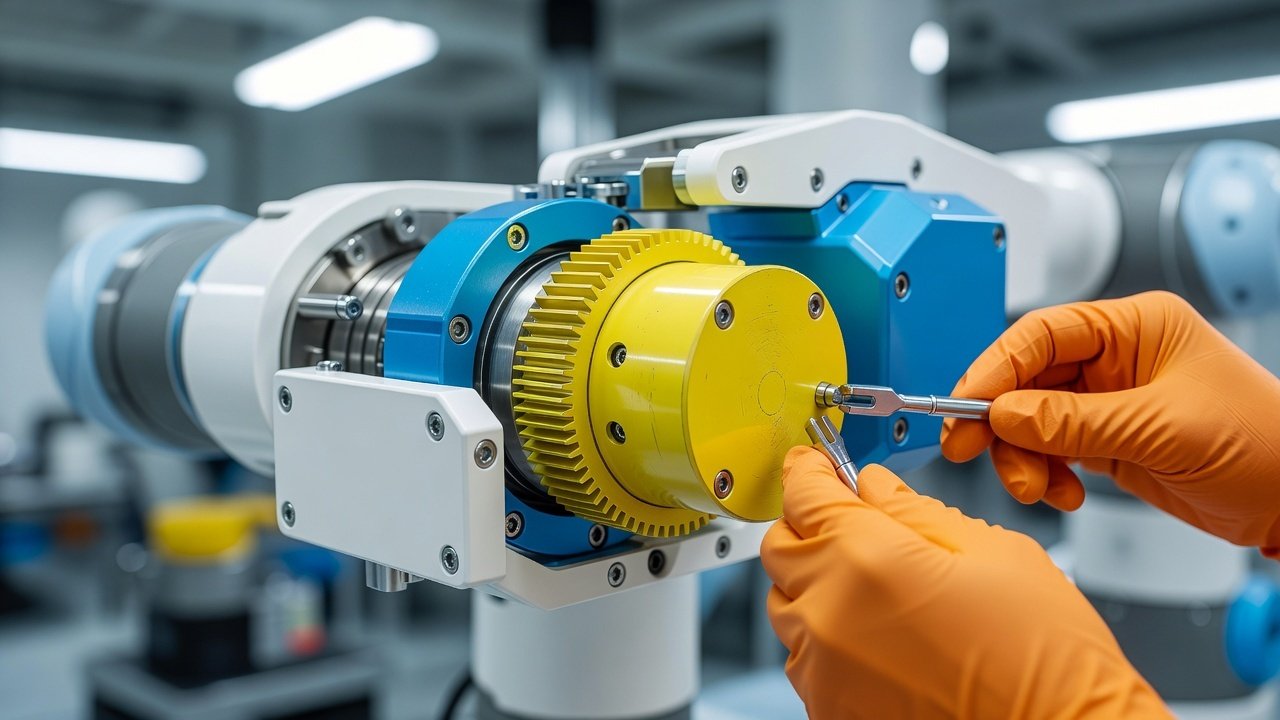
Harmonic drives offer zero backlash and high precision in a compact package, making them ideal for clean, smooth motion control. Cycloidal drives sacrifice some precision for superior shock-load resistance and durability under harsh, reversal-heavy duty. Direct drive eliminates the gearbox entirely, removing backlash and wear but requiring the motor to deliver full torque directly.
Put your finger on the moment the joint changes direction. That instant, more than the headline ratio or the catalog torque, decides whether a harmonic drive will look brilliant for years or a cycloidal drive will shrug off abuse that would slowly crack something else.
The Real Difference: Reversal and Shock
This is the part vendors blur. Both harmonic and cycloidal drives sell the same dream: high reduction in a compact package, good precision, serious torque density. On a short spec sheet, they can pass for substitutes. Then the machine starts doing what real machines do. It stops hard, reverses, gets bumped, catches a load off-center, or spends all day dithering around zero. Suddenly the choice stops being about abstract "performance" and becomes about what kind of punishment your gearbox sees most often.
That is the whole decision in one sentence: harmonic drives reward clean, precise motion control, while cycloidal drives reward harsh, shock-prone duty. The useful turn is narrower than that. The real differentiator is load reversal and shock. Those two conditions reveal how each architecture wears, how its precision changes over time, and whether it degrades gently or reaches a failure point.
Start with why engineers confuse them in the first place. The confusion is rational.
How Each Drive Works
Both are compact, high-ratio reducers. Both show up in robotics and motion systems because a motor alone often spins too fast and too weakly for the output you need. Both can make a small actuator feel much bigger than it is. Both also sound precise in the sales language. That is enough to create the dangerous sentence: "Either one should work."
Usually that sentence appears when the application has not been described in terms of motion events. The spec names ratio, peak torque, envelope, maybe allowable backlash. It leaves out how often the axis reverses, whether it hits mechanical stops, whether the load hangs off the shaft, whether operators ever jog it by hand, whether the controller chatters around a setpoint, whether the machine lives in a clean lab or on a line that bangs parts all shift long. Those omitted details are not side notes. They are the job.
A harmonic drive earns its reputation honestly. It is chosen for high precision, compact size, excellent torque-to-weight ratio, zero backlash, high positional accuracy, and smooth motion. That is why it appears so often in robotics, aerospace, and medical devices. The mechanism helps explain the feel. In a harmonic drive, the input shaft drives a wave generator. The flex spline and circular spline differ in tooth count, and that difference creates the reduction. A 25:1 ratio, for example, uses 50 teeth on the flex spline and 52 teeth on the circular spline. That architecture is how you get a lot of reduction in very little space, and it is why harmonic drives are so attractive when every millimeter matters.
A cycloidal drive also earns its reputation honestly, but for a different reason. It is favored for shock-load resistance, durability, high torque capacity, and the ability to handle overhung loads. That makes it well suited to automation and industrial machinery. The input shaft drives an eccentric bearing, and the reduction ratio follows a different rule: it is always one less than the number of pins on the ring. So the cycloidal answer to the same design problem is not "make it perfectly clean and preloaded." It is "spread the load and survive ugly conditions."
That distinction matters because the most common selection error is to treat backlash as the whole story. It is not.
Engineers hear "zero backlash" and mentally file harmonic drives under "better precision," then assume the rest is a matter of acceptable safety factor. That shortcut works right up until the axis lives near reversal. At reversal, every compliance in the system comes forward. Any impact that rides through the output comes back through the reducer. Any repeated micro-motion around zero turns into a lifetime test. If your machine spends its life making smooth, controlled moves, a harmonic drive's zero-backlash behavior is a gift. If your machine spends its life being yanked back and forth, hit by variable loads, or exposed to repeated shock, the same architecture has a more vulnerable place to hide the damage.
That vulnerable place is the flex spline. In a harmonic drive, the flex spline is the element doing the hard mechanical trick. It is what lets the drive achieve its compact, precise reduction. It is also a primary failure point under repeated shock. That sounds reassuring until you remember how quickly input rotations disappear in a servo axis. Real life depends on duty cycle, torque level, dwell, and reversals, but the point stands: fatigue is not some distant, theoretical concern. It is the clock.
The Moment of Reversal
Now zoom in on the exact moment your joint changes direction.
Imagine a compact robot joint that spends most of its day moving a few degrees clockwise, then a few degrees back, holding position between moves. The payload is not huge. The ratio requirement is high. The package is tight. On paper, this looks like harmonic-drive territory, and often it is. Zero backlash and smooth motion are exactly what make a robot joint feel crisp. The problem starts if those reversals come with frequent external disturbance, poor tuning, hard settling, or occasional knocks from the process. Then the axis is no longer just positioning. It is hammering the same mechanical region again and again.
In that condition, the difference between "precise" and "tough" turns into the difference between two failure shapes.
A harmonic drive often degrades through the flex spline's fatigue path. Early on, it can feel superb. Precision is the selling point, and the architecture delivers it. But repeated shock loads and reversals keep asking the same thin, highly stressed element to do the same trick. The output quality may stay excellent until wear or fatigue crosses a threshold, at which point the decline is not always graceful. What looked like a precision reserve was actually a fatigue budget.
A cycloidal drive behaves differently because its strength comes from load distribution. It carries load across multiple lobes and pins, giving it high durability under shock and overhung loading. It usually does not offer true zero backlash. Its low-backlash performance is fine for most industrial automation and plainly not the same thing as nanometer-level positioning. But when the machine gets rude, that modest backlash number can be the least important fact in the room. The axis may keep working, keep holding ratio, and keep surviving impacts that would age a harmonic drive much faster.
That is the turn many selection discussions miss. Precision is not one number measured on day one. Precision is behavior over time under your actual disturbance pattern. A harmonic drive can begin with tighter positioning. A cycloidal drive can preserve acceptable positioning longer in a violent environment. If your machine lives in clean, smooth, controlled motion, the harmonic drive's starting advantage matters most. If your machine lives in reversals, shocks, and industrial ugliness, the cycloidal drive's ability to absorb abuse matters more than winning the backlash argument in a brochure.
Where Direct Drive Fits
Direct drive belongs in this conversation too, but only if you keep its role straight. Direct drive and hollow shaft motors are specially designed for precision applications. The appeal is obvious. Remove the gearbox and you remove gearbox backlash, gearbox wear modes, and reducer compliance. You also remove the reduction itself, which means the motor must deliver torque directly. That usually changes the motor size, inertia picture, thermal behavior, and cost envelope. Direct drive is not a tie-breaker between harmonic and cycloidal. It is a different answer to the same question: do you want gearing at all?
That is why direct drive often enters the meeting at the wrong time. A team gets stuck between harmonic and cycloidal, then someone says, "What about direct drive?" It sounds elegant because it bypasses the messy tradeoff. But it only works if your actuator can tolerate the consequences of no reduction. For very high ratio needs in a compact package, harmonic and cycloidal remain the live options because both exist to solve exactly that problem. Direct drive matters when your precision demand is so dominant that eliminating the gearbox changes the whole design logic. Otherwise it is a detour.
Choosing Based on Your Axis Biography
So how should you actually choose?
Do not start with ratio. Do not start with peak torque. Start with the axis biography. Write down what the joint does in one representative minute. How many reversals? How many hard stops? Any external impacts? Any overhung loads? Does it hold position under disturbance? Does it dither around zero? What positioning error can the application truly tolerate: zero backlash territory, or low-backlash industrial territory? Those questions map directly onto the architectures.
If the dominant demand is precision in smooth motion, especially when compact size and zero backlash matter, harmonic drives deserve to be at the front of the list. Their appeal is not vague. It is mechanical and immediate. They deliver high positional accuracy and smooth motion in a very small envelope. If the dominant demand is toughness under shock, repeated reversal, and rough industrial duty, cycloidal drives deserve to move ahead because durability and shock-load resistance are their home ground.
Notice the wording: dominant demand. Almost every real machine wants both. The trick is deciding which failure hurts you more. A pick-and-place axis that misses position by a tiny amount may fail the process long before it ever breaks a reducer. A harsh industrial actuator may tolerate a couple of arc-minutes of backlash forever, yet die young if you choose a mechanism that hates repeated shock. One application spends its budget on precision. The other spends it on survivability.
Here is the one thing to do before you request quotes: map a single axis's load profile on paper. Use three lines only: reversal rate, shock frequency, and precision tolerance. If the first two lines are busy, lean cycloidal. If the third line is unforgiving and the first two are calm, lean harmonic. If the third line is so unforgiving that any gearbox compromise breaks the application, investigate direct drive.
Give yourself twenty minutes and do it for one joint this week. Not the whole machine, one joint. The exercise forces the argument out of vendor adjectives and back into mechanics. When you finish, the right reducer usually stops looking mysterious. It starts looking like what it always was: a choice about what happens at the instant the motion turns around.
FAQ
What is the main difference between harmonic and cycloidal drives?
Harmonic drives provide zero backlash and high precision but are more vulnerable to shock and repeated reversals. Cycloidal drives are more durable under harsh conditions but typically have some backlash.
When should I choose a harmonic drive?
Choose a harmonic drive when your application demands high precision, compact size, and smooth motion without significant shock loads or frequent harsh reversals.
When is a cycloidal drive the better option?
A cycloidal drive is better when the application involves shock loads, overhung loads, repeated reversals, or rough industrial duty where durability matters more than zero backlash.
How does direct drive compare to harmonic and cycloidal drives?
Direct drive removes the gearbox entirely, eliminating backlash and reducer wear. However, it requires the motor to deliver full torque directly, which can change motor size, inertia, and cost, making it suitable mainly for very high precision demands.
Questions left? Get in touch →